Research

Three research areas, from detectors to learning hardware

I study how superconducting devices detect light, how large arrays report their signals, and how physical networks can learn from measurements. My earlier work explored the RF response of superconducting materials.

Large-scale single-photon cameras

Superconducting nanowire single-photon detectors combine high sensitivity with low noise. Scaling them into cameras requires efficient readout as well as improvements in fabrication, detection efficiency, and count rate. Our camera combines thermally coupled row and column detectors with shared superconducting buses; pulse arrival-time differences identify the photon’s position.

  • Demonstrated an 800 × 500 active imaging area, with 400 times as many pixels as previous SNSPD arrays (Nature, 2023).
  • Read out the 2023 camera through four superconducting buses and eight microwave coaxial lines, using thermal coupling and time-of-flight multiplexing.
  • Developed and stabilised a 10-layer superconducting nanofabrication process, with test structures validating each step.
  • Improved array yield by introducing advanced lithography at the Boulder Microfabrication Facility, and rebuilt the cryogenic test infrastructure to shorten the prototype–measure–iterate loop.
  • Currently pushing count rate and detection efficiency toward megapixel-class arrays.
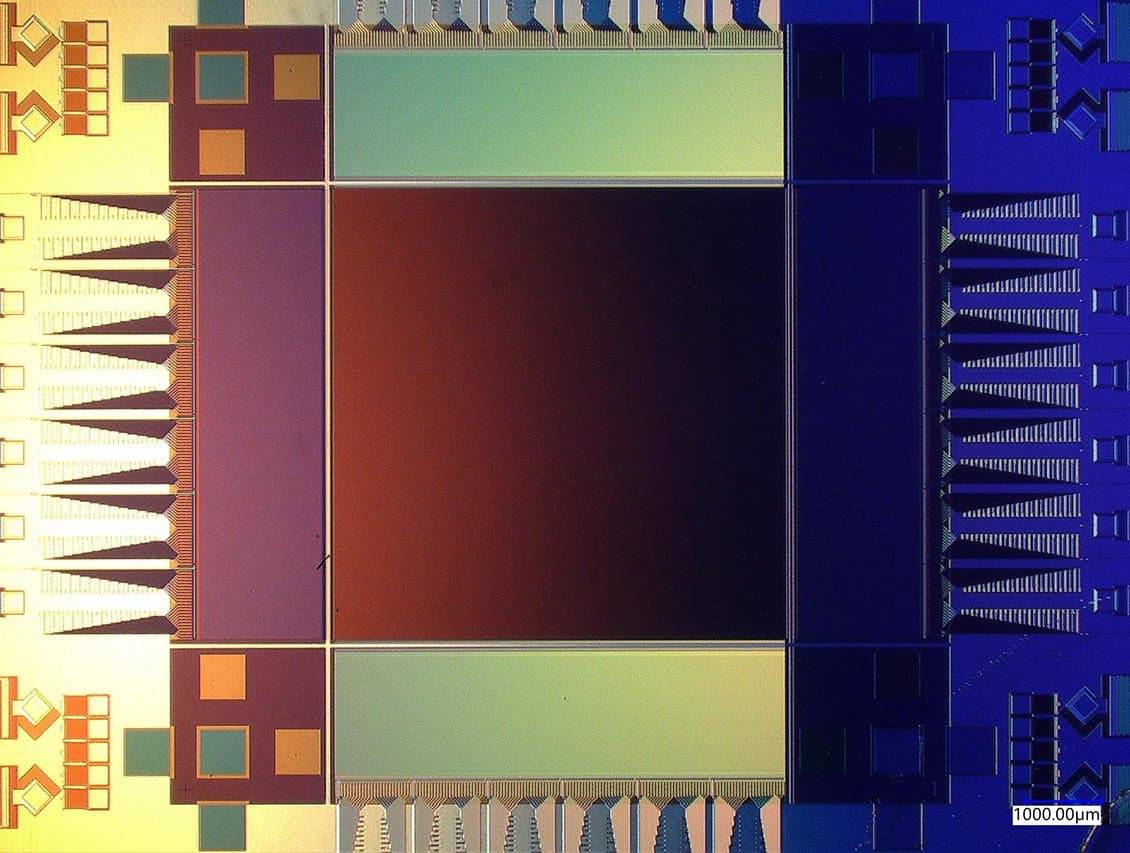
Camera architecture · Nature (2023)

Optical micrograph of the 400,000-pixel superconducting nanowire camera die, showing the central detector array surrounded by tapered readout fan-outs, with a 1 mm scale bar.
The 400,000-pixel camera die. The dark square at the centre is the detector array; the tapered structures on either side fan out to the shared readout lines. Image credit: Adam McCaughan / NIST, via NASA Astrophysics Technology Update 2024.

Training neural networks on physical hardware

Training a physical neural network can be difficult when its response differs from a differentiable model. Multiplexed gradient descent estimates how parameter perturbations affect a measured loss, allowing the network to learn from its own response without a backward pass through a hardware model.

  • Model-free: needs no differentiable simulation of the hardware.
  • Showed that time to reach a target accuracy need not grow linearly with parameter count and can decrease as networks grow, in the tasks studied (APL Machine Learning, 2025).
  • Extended to recurrent networks and to astrocyte-inspired update rules.

Training and scaling · APL Machine Learning (2025)

Learning from the response of physical hardwareParameter perturbations enter a physical network. Its output is compared with a target to measure loss. Correlating loss changes with perturbations estimates a gradient, which updates the parameters and closes the training loop.PerturbparametersPhysicalnetworkMeasure lossagainst targetEstimategradientUpdate parametersTrain using measured responses
Conceptual training loop: perturb the parameters, measure the loss, estimate a gradient, and update the network. Based on multiplexed gradient descent; see the linked paper for methods and scaling results.

Superconducting RF materials

Doctoral work on why superconducting accelerator cavities quench below their theoretical limit — a question about the first hundred nanometres of a niobium surface.

  • Built a scanning near-field magnetic microwave microscope for localised defect characterisation.
  • Showed the nonlinear response signature originates at Josephson-junction-like surface defects.
  • Simulated rf vortex nucleation as semiloops using time-dependent Ginzburg–Landau in COMSOL.
  • Built a 50 mK cavity test facility, including PLL feedback and magnetic shielding with >5000× attenuation.

Vortex simulations · Physical Review E (2020)

Local RF excitation and vortex penetrationA localized RF magnetic source sits above a superconducting surface. A schematic vortex semiloop extends below the surface. Microscopy measures nonlinear response, while time-dependent Ginzburg–Landau simulations study vortex dynamics. This diagram is conceptual, not simulation output.Localized RF magnetic fieldSurfaceSuperconductorMicroscopy measurements + TDGL simulationsVortex semiloop
Conceptual cross-section of vortex penetration beneath a localized RF field. The semiloop illustrates the mechanism studied with time-dependent Ginzburg–Landau simulations; it is not a measured image or simulation result.

Background

Full detail in the CV.

Experience

Research Associate
NIST Boulder / University of Colorado
Applied Physics Division — Faint Photonics Group
Feb 2021 – present
Research Assistant
Quantum Materials Center, University of Maryland
Advisor: Prof. Steven M. Anlage
Jun 2014 – Aug 2020
Research Assistant
Institute for Research in Electronics and Applied Physics, UMD
Jan 2014 – Jun 2014

Education

Ph.D. in Physics
University of Maryland, College Park
Superconducting RF materials science through near-field magnetic microscopy
2013 – 2020
Data Science Scholar
The Data Incubator
Selective data science fellowship (≈3% admission rate)
2020
B.Sc. in Physics (Honors List)
Boğaziçi University, Istanbul
2008 – 2012

Techniques

Superconducting devices

SNSPDsSRF cavitiesThin-film resonatorsNanocryotronsCryogenic device physics

Nanofabrication

E-beam lithographyPhotolithographySputtering / evaporationPECVDReactive ion etching

Cryogenics

Dilution refrigerators (~50 mK)Sorption refrigerators (~1 K)Cryogenic probe stationsMagnetic shielding

RF & microwave

Network analyzersSpectrum analyzersLock-in amplifiers

Modeling & simulation

COMSOL (TDGL, multiphysics)Ansys HFSSLTspice

Machine learning & software

Hardware-aware trainingJAXPythonMeasurement automationHPC

Awards

NIST PEAR Technical Accolade Award
2024
Bronze Medal, International Physics Olympiad (IPhO)
39th IPhO, Vietnam
2008
Bronze Medal, Asian Physics Olympiad (APhO)
9th APhO, Mongolia
2008
Gold Medal, Tajikistan Nationwide Physics Olympiad
2008

Service

  • Reviewer, NSF ENG/EFMA panel
  • Reviewer, Applied Physics Letters (AIP)
  • Reviewer, Review of Scientific Instruments (AIP)
  • Reviewer, Advanced Photonics (SPIE)
  • Reviewer, Nanoscale (Royal Society of Chemistry)

Languages

EnglishRussianTurkishTajikPersian